
International Street Work Conference 2026 Concludes Following Hong Kong Debut
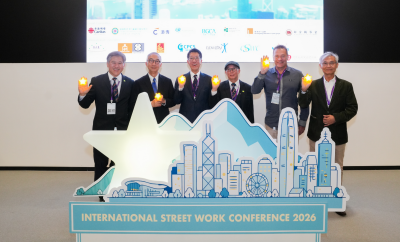 Mr Edward To Wing-hang, JP, Director of Social Welfare (third from left); Mr Edwin DE BOEVÉ, Director of Dynamo International – Street Workers Network (fifth from left); Mr Arthur Li, Chairman of Hong Kong Playground Association (fourth from left); Profes
Delegates from 40 Countries and Regions Discuss Emerging Youth Challenges and Strengthen Cross-Sector Collaboration
HONG KONG SAR - Media OutReach Newswire - 11 November 2026 - The International Street Work Conference 2026 concluded on 8 November at Saint Francis University, marking the first time the international conference was held in Hong Kong. Jointly organised by the Children and Youth Research Centre of Saint Francis University and Hong Kong Playground Association, the conference brought together representatives from 40 countries and regions across five continents, representing more than 80 international and local organisations. More than 400 academics, experts, frontline youth workers and social workers from places including Albania, Belgium, Brazil, Canada, Greece, India, Portugal, Senegal, Singapore, Spain and Vietnam attended the event.
Through keynote presentations, research sharing and international exchanges, the conference focused on six key areas affecting young people: mental health, digital safety, drug and alcohol abuse, violence, career development & employment, and street work. Participants explored the challenges facing youth services worldwide and discussed directions for future development.
The opening ceremony was held on 7 November, officiated by Mr Edward To Wing-hang, JP, Director of Social Welfare of the Hong Kong Special Administrative Region; Mr Edwin DE BOEVÉ, Director of Dynamo International – Street Workers Network; Mr Arthur Li, Chairman of Hong Kong Playground Association; Professor Lui Tai-lok, Research Professor of Felizberta Lo Padilla Tong School of Social Sciences at Saint Francis University; Professor Francis Lo Tit-wing, Co-chairman of the Organising Committee of the International Street Work Conference 2026 and Vice President (Research and Innovation) of Tung Wah College; and Dr Wan Lap-man, Co-chairman of the Organising Committee and Executive Director of Hong Kong Playground Association.
Mr Edwin DE BOEVÉ, Director of Dynamo International – Street Workers Network, said, "We organise an international conference every two years to provide street workers with opportunities for in-depth exchanges. We are grateful to Hong Kong for hosting this year's conference and for the thoughtful arrangements and opportunities to engage with local communities, which contributed to the smooth running of the event. We are also delighted to welcome Singapore as a new member and hope to see our network continue to grow."
Professor Lui Tai-lok, Research Professor of Felizberta Lo Padilla Tong School of Social Sciences at Saint Francis University, said, "As one of Hong Kong's universities of applied sciences, Saint Francis University is committed to building strong partnerships with different industries and communities, combining professional training with academic excellence. This conference is a successful example of that commitment in action."
Professor Francis Lo Tit-wing, Co-chairman of the Organising Committee of the International Street Work Conference 2026 and Vice President (Research and Innovation) of Tung Wah College, said, "In 1979, the Hong Kong Government established the direction and status of outreaching social work services for young people. At that time, there were 18 daytime outreaching social work teams across Hong Kong, with 180 outreach social workers serving different communities. Today, the sector has developed to a stage where professionals can collaborate with counterparts around the world. It is encouraging to see so many people gathered here today to share their experiences."
Dr Wan Lap-man, Co-chairman of the Organising Committee of the International Street Work Conference 2026 and Executive Director of Hong Kong Playground Association, said, "Street work is not simply about reaching out to young people on the streets. More importantly, it is about building trust, walking alongside them, and bringing them hope and the prospect of a better future. We would like to thank the Social Welfare Department and 18 local organisations for their support in making this two-day conference and its accompanying activities possible."
Collaborative Asia-Pacific Study of 1,116 Children and Young People Reveals Mental Well-being and Digital Safety Challenges
At the keynote presentation titled Hidden Risks, Visible Needs: Mental Wellness and Digital Safety in Asia-Pacific Street Youth Populations, Dr Wan Lap-man, Co-chairman of the Conference Organising Committee and Executive Director of Hong Kong Playground Association, and his research team shared findings from a study covering six countries and regions in the Asia-Pacific.
The study collected data from 1,116 young people in Hong Kong, Australia, India, Nepal, the Philippines and Timor-Leste. It examined the living conditions and potential needs of young people experiencing street involvement and other forms of vulnerability, focusing on mental well-being, resilience, emotional distress, street survival risks and digital safety. The findings provide an evidence-based reference for frontline youth support services and intervention strategies.
The study found that resilience is an important factor closely associated with young people's mental well-being. After controlling for factors including age, gender and country or region, the data showed that every one-point increase in resilience was associated with an average increase of 5.41 points in the mental well-being index. The statistical model also explained nearly 48% of the variation in mental well-being. These findings highlight the importance of strengthening support networks, fostering relationships with trusted adults and promoting community connections to help young people build resilience.
Living conditions were also found to be closely associated with young people's psychological well-being. Among the street-involved and vulnerable young people surveyed, those living in formal shelters generally reported better psychological well-being, lower levels of emotional distress and stronger resilience. Their psychological well-being scores were, on average, approximately 17.6 points higher than those of young people living in other settings. This suggests a close relationship between safe, supportive living environments and young people's psychological well-being.
In contrast, young people staying temporarily with friends reported lower levels of psychological well-being and resilience, as well as higher levels of emotional distress. This highlights the often-overlooked needs of young people experiencing hidden homelessness and underscores the importance of extending youth services beyond those who are visibly homeless on the streets.
In terms of digital safety, the study identified a strong positive correlation between street survival risks and digital safety risks (r = 0.619). Street survival risks included hunger, the lack of a safe place to sleep, exposure to violence or control, and making high-risk choices to survive. This suggests that young people facing greater risks in their everyday lives also tend to face greater threats to their safety online.
The study also found that young people of different genders faced different challenges. Female participants reported lower levels of mental well-being and resilience, alongside higher levels of emotional distress. Male participants, meanwhile, recorded higher overall scores for street survival risks. These findings highlight the need for youth support services to adopt tailored strategies that address the circumstances and needs of different groups.
Of particular concern, nearly one-third (31.15%) of young people experiencing severe emotional distress reported current suicidal thoughts, highlighting the importance of early risk identification, timely psychological support and effective referral mechanisms.
Conference Sessions Explore Drug Trends and Social Networks Among Street-Connected Youth
Over the two-day conference, nearly 40 presentations and workshops explored challenges facing street-connected young people, covering international policy, youth social networks, juvenile offending and drug-related issues.
Mr Edwin DE BOEVÉ, Director of Dynamo International – Street Workers Network, delivered a presentation titled Social Street Work on the International Agenda, sharing insights into the development and positioning of social street work on the international agenda. He also explored how international networks can work together to support young people and vulnerable communities.
Professor Jessica Li Chi-mei, Associate Professor of the Department of Applied Social Sciences at The Hong Kong Polytechnic University, presented a study titled Risk Perception and Reward Expectancy in the Illicit Use of Etomidate Among Young People in Hong Kong: A Qualitative Study. The presentation examined how young people in Hong Kong perceive the illicit use of etomidate, commonly known as "space oil", including their understanding of the associated risks and the considerations behind its use. The study aimed to deepen understanding of why young people are exposed to and use space oil, providing insights for related prevention education and support services.
Another presentation, The Science of Lepaking, explored how street-connected young people in Singapore chose their companions and formed group relationships known as "street families" before and during the COVID-19 pandemic, gaining a sense of belonging and protection through these connections. The research team conducted in-depth recorded interviews with young people and invited outreach social workers from local youth service organisations to participate in discussions. The study explored the factors influencing young people's choice of companions, including gender differences, providing insights for the development of more targeted street outreach strategies.
Other presentations also explored the role of social work in preventing and addressing juvenile offending, with participants sharing practical experiences and approaches to supporting young people in different regions.
HKPA Showcases Innovative Digital Support and Street Music Initiatives to Engage Hidden Youth
In addition to keynote presentations and research exchanges, Hong Kong Playground Association shared its practical experience in local youth services. These included the "FEEL3 Youth at Cyber Risk Support Service", which helps young people respond to cyberbullying and online crises, and the "Make Some Voice" Street Music Project, which uses music and creative activities to engage hidden youth who may be less likely to actively seek help, while establishing channels for trust and communication.
The conference also arranged visits for overseas delegates to local service organisations, including first-hand observations of night-time youth outreach services. Through these visits, delegates gained a better understanding of the daily operations and service models of frontline youth work in Hong Kong, exchanged experiences with local practitioners and explored opportunities for mutual learning and collaboration across regions.
Through two days of international exchanges, the International Street Work Conference 2026 successfully connected researchers, policymakers and frontline youth workers from different countries and regions, highlighting the important role of street work in responding to the challenges facing young people today.
The organisers hope that the conference will help establish closer international partnerships and promote continued knowledge exchange and service innovation. Youth services should not focus solely on addressing risks, but also place emphasis on building trust, strengthening support networks and enhancing resilience, enabling children and young people to grow up in safe and supportive environments.
Hashtag: #InternationalStreetWorkConference2026 #ISWC2026 #StreetWork
 https://www.iswconference.com/
The issuer is solely responsible for the content of this announcement.
About the International Street Work Conference 2026
Dynamo International – Street Workers Network
The Street Workers Network is a social movement led by street workers. Guided by a strong sense of civic responsibility, its members are committed to upholding human rights, combating inequality and promoting social justice to support the most vulnerable groups, particularly those living in street situations.
The Network brings together 57 national platforms, representing more than 1,600 organisations and 10,000 street workers across Africa, the Americas, Asia-Pacific and Europe. Through the continuous enhancement of its organisational structure and operational framework, the Network has progressively built a genuine and influential global solidarity network, enabling street workers to advance their professional development and strengthen mutual support and collaboration in serving marginalised communities.
The International Street Work Conference is held biennially in different regions around the world. In 2026, the conference was held in Hong Kong, China for the first time. It was jointly organised by the Children and Youth Research Centre (CYRC) of Saint Francis University and Hong Kong Playground Association.
This year's Conference brought together over 400 participants from more than 80 organisations across 40 countries and regions spanning five continents, providing an international platform for professional exchange and collaboration in youth services.
Through keynote speeches, thematic discussions and interactive workshops, the Conference explored six key areas: mental well-being, digital safety, drug and alcohol abuse, violence, career development and employment, and street outreach work. Participants shared frontline service experiences, research findings and innovative intervention strategies, while exploring service approaches to address the needs of young people and marginalised communities and strengthening collaboration between international and local youth service networks.
For more information, please visit: https://www.iswconference.com/
About Children and Youth Research Centre of Saint Francis University
Established in January 2024, the Children and Youth Research Centre (CYRC) is funded by the Competitive Research Funding Schemes (UGC/IDS(R)11/23) for the Local Self-Financing Degree Sector of Research Grants Council in Hong Kong.
The CYRC aims to improve the wellbeing of children and youth in Hong Kong by addressing the complex needs and challenges they face in a rapidly evolving economic, cultural, and social environment through conducting scientific research, facilitating cost-effective service programmes, and informing policy decisions.
Saint Francis University (SFU), formerly known as Caritas Institute of Higher Education and originally established as Caritas Francis Hsu College, has a history of more than 40 years in higher education. In 2024, the institution was officially granted university status and became a University of Applied Sciences (UAS) in the same year.
As a pioneer among Hong Kong's Universities of Applied Sciences, SFU integrates theory with practice and offers more than 40 programmes at different levels, including bachelor's and master's degrees. Its programmes cover a wide range of professional disciplines, including health sciences, social sciences, techno-humanities, and business administration. The University is committed to nurturing a new generation of talent equipped with professional knowledge and a spirit of lifelong learning.
About Hong Kong Playground Association
Established in 1933, Hong Kong Playground Association is a long-time non-governmental organisation providing social services to children and young people in Hong Kong.
The Association's services are organised under "Central Administration & Corporate Communication Division", "Social Work Division" and "Culture, Sports & Arts Division". Service units are located across Hong Kong Island, Kowloon, the New Territories and outlying islands.
Through a diverse range of services, HKPA is committed to nurturing the balanced physical, intellectual, moral, social and aesthetic development of young people, helping them grow into the next generation of contributors to Hong Kong society.
-
01Rabu, 11 November 2026 - 16:51:25
Tak Menunggu Bantuan, Warga Batu Teritip Swadaya Bangun Fasilitas Kesehatan untuk Ibu dan Anak
-
02Rabu, 11 November 2026 - 16:51:12
Pertamina Patra Niaga Kilang Dumai Perkuat Budaya Keselamatan Kerja Lewat Personal Risk Assessment BETUAH
-
03Rabu, 11 November 2026 - 16:00:28
HKSTP Achieves Fruitful Success at Inaugural Participation in Singapore Urban Mobility Week 2026
-
04
-
05Rabu, 11 November 2026 - 15:00:27
International Street Work Conference 2026 Concludes Following Hong Kong Debut
-
06Rabu, 11 November 2026 - 15:00:27
WellEra and Capella Bring Together the Science of Wellness and the Art of Hospitality at Thailand’s First Capella-Branded Residences
-
07Rabu, 11 November 2026 - 14:00:27
Huawei Launches LUTERRA® S2, Redefining the Future of Residential Energy Systems with Three Ultimate Innovations
-
08Rabu, 11 November 2026 - 13:48:03
Kelompok Tani Senepis Mulai Semai 210 Kg Benih Padi Logawa, Dorong Penguatan Ketahanan Pangan di Dumai
-
09Rabu, 11 November 2026 - 13:00:27
Ayam Brand™ Nurtures Healthier Futures with #AyamBersamaMu: Bekal Sihat Masa Depan
-
010Rabu, 11 November 2026 - 12:00:28
Malaysia Airlines Secures Major Accolades for Service and MICE Offering