

Shell and St. Paul's Hospital Drive low-carbon development in Hong Kong’s healthcare sector
City’s first hospital to adopt Renewable Diesel Blend R33, reducing up to 30% lifecycle CO2e emissions
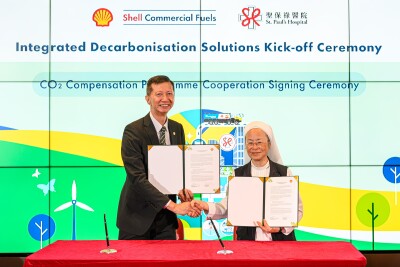
HONG KONG SAR - Media OutReach Newswire - 18 June 2026 - Shell Hong Kong Limited (Shell) and St. Paul's Hospital on Tuesday held the "Shell x St. Paul's Hospital – Integrated Decarbonisation Solutions Kick-off Ceremony", reinforcing their shared commitment to sustainable development. As one of the world's largest suppliers of biofuels, Shell has been promoting renewable diesel as a practical, lower-carbon energy solution. St. Paul's Hospital is the first hospital in Hong Kong to adopt Shell Renewable Diesel Blend R33¹ for its boiler system. The switch required no modification to its existing equipment and offers up to 30%2 less CO2e emissions on a life cycle basis3 compared to EN 590 B0 diesel4. In addition, St. Paul's Hospital installed Shell Recharge electric vehicle charging facilities in its parking lot and joined Shell's CO2 Compensation Programme as part of its low-carbon initiatives.
First hospital in Hong Kong: adopting renewable diesel for boiler systems
Shell is committed to "Power Progress Together" by working together with their customers and partners, to provide the energy products that people need to power their lives and businesses today, while helping to build the low-carbon energy system of the future. With Shell's support, St. Paul's Hospital has pioneered a healthcare first in Hong Kong to implement Shell Renewable Diesel Blend R331 to power its boiler system.

Renewable diesel: enabling value chain decarbonisation for businesses
In response to St. Paul's Hospital's need for a stable low-carbon energy solution, Shell introduced Renewable Diesel Blend R331, which offers up to 30%2 less CO2e emissions on a life cycle basis3 compared to EN 590 B0 diesel4, helping the hospital reduce value chain emissions and meet its Scope 1 and Scope 2 targets.
Compatible with conventional diesel equipment
The launch of Shell Renewable Diesel marks a significant milestone in Shell's support in the energy transition journey in Hong Kong. Mr. Dick Chan, General Manager of Shell Commercial Fuels – Hong Kong and Macau of Shell Hong Kong Limited, said: "We are honoured to witness St. Paul's Hospital becoming a low-carbon promoter in Hong Kong's healthcare sector, as the first to adopt Shell Renewable Diesel Blend R331. This represents the shared commitment of both the energy sector and the healthcare sector to work together for a sustainable future."
Businesses selecting sustainable low-carbon energy solutions often face challenges such as capital investment, equipment compatibility, and operational impact. Shell Renewable Diesel is fully compatible with conventional diesel boilers or engines and can serve as a direct replacement fuel without any modifications or adding new equipment5, helping businesses lower costs and emissions. It also reduces regulated air pollutants6, making it suitable for use across various industries including construction, transport and logistics, industrial operations, and healthcare.
Comprehensive technical support for a smooth transition
A hospital's boiler system is essential to daily operations. It supplies hot water and steam for the central heating system, wards, operating theatres, laundry services, and sterilisation equipment. Any disruption to boiler operations would have a significant impact on the hospital functioning. For this reason, St. Paul's Hospital places great importance on the stability of its fuel supply. Switching to Shell Renewable Diesel Blend R331 required no modification to the hospital's existing boiler system. To ensure a smooth transition, Shell provided professional technical support and conducted comprehensive inspections of the boiler system before the switch to ensure continued safe and reliable operation.
Mr. Gilbert Lee, General Manager of St. Paul's Hospital, welcomed the collaboration. He said: "It is an undeniable fact that renewable energy has become a key direction of future energy transition, aligning with the global trend towards low carbon and environmental sustainability. Looking ahead, St. Paul's Hospital will continue to collaborate with different sectors to promote more practical and effective low-carbon measures, contributing to a greener and healthier future for both the hospital and the wider community."
Advancing low-carbon operations towards a sustainable future
In addition, St. Paul's Hospital continues to advance low-carbon operations through its collaboration with Shell, taking a multi-pronged approach to building a low-carbon energy ecosystem. This includes the installation of two 50kW Shell Recharge fast-charging facilities in the hospital's parking lot, providing visitors and staff with a more environmentally friendly and convenient energy option. At the same time, the hospital has adopted low-carbon fuel solutions and actively participated in Shell's CO? Compensation Programme, supporting independently verified environmental, technology, and waste management projects. Through a simple and cost-efficient approach, these initiatives help compensate unavoidable carbon emissions from daily operations while promoting sustainable development in the communities where the projects are located.
Together, these initiatives not only enhance the hospital's overall sustainability performance but also encourage the healthcare sector to explore low-carbon operational models, contributing to a healthier and more sustainable future.
Shell will continue to work with St. Paul's Hospital and other partners to promote practical low-carbon solutions, which fully support Hong Kong's goal of achieving carbon neutrality by 2050 and create a sustainable environment for future generations.
Notes:
- Shell Renewable Diesel Blend R33 contains up to 33% ISCC-certified renewable components.
- Between 27% and 30% less CO2e. CO2e (carbon dioxide equivalent) includes CO2, CH4, N2O emissions.
- The life-cycle assessment of a product's CO2e emissions includes emissions associated with feedstock production, feedstock transport, fuel production, fuel transportation and distribution, and combustion.
- Calculated by comparing to a GHG baseline intensity of 92g CO2e/MJ on a Well-to-Wheel basis, representative of an EN590 B0 diesel and calculated by Shell with emission factors from JEC Well-to-Tank report v5 (Link: https://data.europa.eu/doi/10.2760/959137) and internal Shell studies.
- When switching from diesel. Based on Shell's operability studies and market experience to date. Vehicle handbook and/or label at the fuel tank socket must be checked for OEM approval. Not applicable for passenger cars.
- Actual effects and benefits may vary according to vehicle type, vehicle condition and driving style. Compared to EN590 B0 diesel. Not applicable for passenger cars. The tailpipe out emission benefit can be limited for vehicles with advanced exhaust aftertreatment systems.
- Between 80% and 90% less CO2e. CO2e (carbon dioxide equivalent) includes CO2, CH4, N2O emissions.
Forward-Looking statements
This content contains forward-looking statements (within the meaning of the U.S. Private Securities Litigation Reform Act of 1995) concerning the financial condition, results of operations and businesses of Shell. All statements other than statements of historical fact are, or may be deemed to be, forward-looking statements. Forward-looking statements are statements of future expectations that are based on management's current expectations and assumptions and involve known and unknown risks and uncertainties that could cause actual results, performance or events to differ materially from those expressed or implied in these statements. Forward-looking statements include, among other things, statements concerning the potential exposure of Shell to market risks and statements expressing management's expectations, beliefs, estimates, forecasts, projections and assumptions. These forward-looking statements are identified by their use of terms and phrases such as "aim"; "ambition"; ''anticipate''; "aspire", "aspiration", ''believe''; "commit"; "commitment"; ''could''; "desire"; ''estimate''; ''expect''; ''goals''; ''intend''; ''may''; "milestones"; ''objectives''; ''outlook''; ''plan''; ''probably''; ''project''; ''risks''; "schedule"; ''seek''; ''should''; ''target''; "vision"; ''will''; "would" and similar terms and phrases. There are a number of factors that could affect the future operations of Shell and could cause those results to differ materially from those expressed in the forward-looking statements included in this content, including (without limitation): (a) price fluctuations in crude oil and natural gas; (b) changes in demand for Shell's products; (c) currency fluctuations; (d) drilling and production results; (e) reserves estimates; (f) loss of market share and industry competition; (g) environmental and physical risks, including climate change; (h) risks associated with the identification of suitable potential acquisition properties and targets, and successful negotiation and completion of such transactions; (i) the risk of doing business in developing countries and countries subject to international sanctions; (j) legislative, judicial, fiscal and regulatory developments including tariffs and regulatory measures addressing climate change; (k) economic and financial market conditions in various countries and regions; (l) political risks, including the risks of expropriation and renegotiation of the terms of contracts with governmental entities, delays or advancements in the approval of projects and delays in the reimbursement for shared costs; (m) risks associated with the impact of pandemics, regional conflicts, such as the Russia-Ukraine war and the conflict in the Middle East, and a significant cyber security, data privacy or IT incident; (n) the pace of the energy transition; and (o) changes in trading conditions. No assurance is provided that future dividend payments will match or exceed previous dividend payments. All forward-looking statements contained in this content are expressly qualified in their entirety by the cautionary statements contained or referred to in this section. Readers should not place undue reliance on forward-looking statements. Additional risk factors that may affect future results are contained in Shell plc's Form 20-F for the year ended December 31, 2025 (available at www.shell.com/investors/news-and-filings/sec-filings.html and www.sec.gov). These risk factors also expressly qualify all forward-looking statements contained in this contentand should be considered by the reader. Each forward-looking statement speaks only as of the date of this content. Neither Shell plc nor any of its subsidiaries undertake any obligation to publicly update or revise any forward-looking statement as a result of new information, future events or other information. In light of these risks, results could differ materially from those stated, implied or inferred from the forward-looking statements contained in this content.
Shell's net carbon intensity
Also, in this contentwe may refer to Shell's "net carbon intensity" (NCI), which includes Shell's carbon emissions from the production of our energy products, our suppliers' carbon emissions in supplying energy for that production and our customers' carbon emissions associated with their use of the energy products we sell. Shell's NCI also includes the emissions associated with the production and use of energy products produced by others which Shell purchases for resale. Shell only controls its own emissions. The use of the terms Shell's "net carbon intensity" or NCI is for convenience only and not intended to suggest these emissions are those of Shell plc or its subsidiaries.
Shell's net-zero emissions target
Shell's operating plan and outlook are forecasted for a three-year period and ten-year period, respectively, and are updated every year. They reflect the current economic environment and what we can reasonably expect to see over the next three and ten years. Accordingly, the outlook reflects our combined Scope 1 and 2 target, NCI target and our oil products ambition over the next ten years. However, Shell's operating plan and outlook cannot reflect our 2050 net-zero emissions target, as this target is outside our planning period. Such future operating plans and outlooks could include changes to our portfolio, efficiency improvements and the use of carbon capture and storage and carbon credits. In the future, as society moves towards net-zero emissions, we expect Shell's operating plans and outlooks to reflect this movement. However, if society is not net zero in 2050, as of today, there would be significant risk that Shell may not meet this target.
Forward-Looking non-GAAP measures
This content may contain certain forward-looking non-GAAP measures such as free cash flow and underlying operating expenses. We are unable to provide a reconciliation of these forward-looking non-GAAP measures to the most comparable GAAP financial measures because certain information needed to reconcile those non-GAAP measures to the most comparable GAAP financial measures is dependent on future events some of which are outside the control of Shell, such as oil and gas prices, interest rates and exchange rates. Moreover, estimating such GAAP measures with the required precision necessary to provide a meaningful reconciliation is extremely difficult and could not be accomplished without unreasonable effort. Non-GAAP measures in respect of future periods which cannot be reconciled to the most comparable GAAP financial measure are calculated in a manner which is consistent with the accounting policies applied in Shell plc's consolidated financial statements.
The contents of websites referred to in this content do not form part of this content.
We may have used certain terms, such as resources, in this content that the United States Securities and Exchange Commission (SEC) strictly prohibits us from including in our filings with the SEC. Investors are urged to consider closely the disclosure in our Form 20-F, File No 1-32575, available on the SEC website www.sec.gov.
Hashtag: #Shell #StPaulsHospital #ESG #LowCarbon
The issuer is solely responsible for the content of this announcement.
About Shell
Shell Hong Kong (Shell) is an operating company of Shell plc – a global group of energy and petrochemical companies which use advanced technologies and take an innovative approach to help build a sustainable energy future. With more than 100 years of history locally, Shell supplies Hong Kong and Macau with a wide range of oil products from its technologically advanced Tsing Yi Installation. Shell's business activities include Retail filling and service stations, fuel and lubricants to Commercial sectors, Bitumen, Aviation fuel, Marine fuel and lubricants. As a responsible corporate citizen in Hong Kong, Shell actively contributes to the well-being of the community through its social investment programmes.
About Shell Renewable Diesel
Shell Renewable Diesel is a high-quality Hydrotreated Vegetable Oil (HVO) made with 100% renewable bio-components such as used cooking oil, animal fats, crop-based or other wastes through hydrogenation (treatment with hydrogen). Compared to EN 590 B0 diesel 4, Shell Renewable Diesel can reduce CO2e emissions by up to 90%7 on a lifecycle basis 3.
Shell Renewable Diesel Blend R331 contains up to 33% renewable content — including 7% Fatty Acid Methyl Ester (FAME) and 26% Hydrotreated Vegetable Oil (HVO) — and complies with the European EN 590 diesel standard. It offers up to 30%2 less CO2e emissions on a life cycle basis3 compared to EN 590 B0 diesel4
About Shell's CO? Compensation Programme
Shell is one of the most established traders of carbon credits in the world. On the journey to reduce carbon emissions, Shell offers commercial customers carbon offset solutions that provide a simple and cost-effective way to offset hard-to-abate emissions. Shell automatically helps commercial customers calculate their carbon emissions and offsets them through carbon credits generated from various environmental, technology and waste management projects – such as initiatives related to protecting or re-developing natural ecosystems like forests, grasslands and wetlands, as well as investing in renewable energy and low-emission cooking appliances – to reduce concentrations of greenhouse gases in the atmosphere.
These projects include the Reducing Emissions from Deforestation and Forest Degradation (REDD+) project in Congo, the protection of peat swamp forests in Indonesia, and tropical forest protection projects in Acre, Brazil. Taking the Katingan Mentaya Wildlife and Conservation Project in Indonesia as an example, it protects approximately 150,000 hectares of intact peat swamp forest and five endangered species, generating an average of 7.45 million carbon credits each year (equivalent to offsetting 7.45 million tonnes of CO2e) – an impact equivalent to removing 2 million cars from the road each year, making a significant contribution to global carbon reduction.
- Binzhou Aerospace Exploration Center, New Landmark for Science, Cultural Tourism
- 2026 Tour of Binzhou Int'l Cycling Race Kicks Off
- Vitals Announces Telehealth Rollout in Thailand as Bruce Rockowitz Highlights Data-Driven Wellness
- AS Watson Delivers 10% Global Health Growth Powered by 3,300+ Pharmacists Advancing Preventive Healthcare Worldwide
- Markforged Appoints Unotech as Exclusive Distributor in Hong Kong
- Thailand Unveils First National Semiconductor Strategy, Targets $80 Billion in Investment by 2050

.jpg)
Untuk Berbagi Berita / Informasi / Peristiwa
Silahkan SMS ke nomor HP : 0853-6543-3434/0812-6686-981
atau email ke alamat : redaksimonitorriau@gmail.com
Harap camtumkan detail data diri Anda
Pengutipan Berita dan Foto, Cantumkan Monitorriau.com Sebagai Sumber Tanpa Penyingkatan